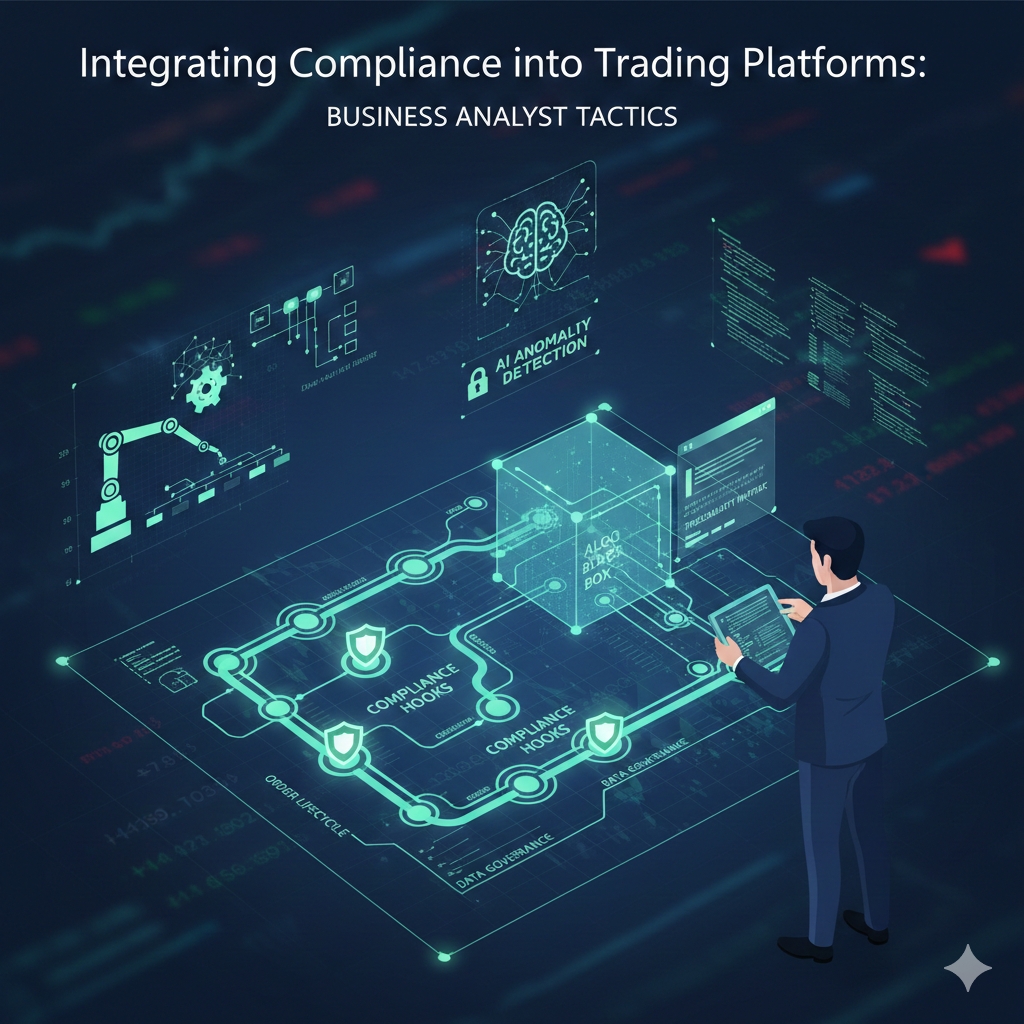


Historically, compliance was an "after-the-fact" check—a post-trade report generated at the end of the day. In today’s high-frequency, multi-asset environments, that model is obsolete. Modern regulators, including the SEC, FCA, and CIRO, now expect "compliance by design." This means the system must prevent violations before they happen, rather than just reporting them later.
For a Business Analyst, this requires moving beyond simple requirements gathering to Operationalizing Regulation.
The most effective tactic for a BA is to map the entire trade lifecycle—from order entry to clearing—and identify specific "hooks" where compliance checks must occur.
Algorithmic trading platforms often operate as "black boxes," making them a nightmare for compliance officers. The BA’s role is to enforce transparency through Algorithm Documentation & Logic Verification.
Compliance is only as good as the data feeding it. BAs must lead the charge on Data Normalization.
In 2026, trading platforms often ingest data from disparate sources—cloud-based Order Management Systems (OMS), legacy Execution Management Systems (EMS), and external market data feeds. A BA ensures that a "Buy" order in one system and a "Purchase" in another are normalized into a single, compliant data record. This prevents "false positives" that exhaust compliance teams and allows for accurate Cross-Market Surveillance.
Automation is the BA’s greatest tool for scaling compliance.
BA Blocks
Industry Certification Programs:
CFA(Chartered Financial Analyst)
FRM(Financial Risk Manager)
CAIA(Chartered Alternative Investment Analyst)
CMT(Chartered Market Technician)
PRM(Professional Risk Manager)
CQF(Certificate in Quantitative Finance)
Canadian Securities Institute (CSI)
Quant University LLC
· MachineLearning & AI Risk Certificate Program
ProminentIndustry Software Provider Training:
· SimCorp
· Charles River’sEducational Services
Continuing Education Providers:
University of Toronto School of Continuing Studies
TorontoMetropolitan University - The Chang School of Continuing Education
HarvardUniversity Online Courses
Study of Art and its Markets:
Knowledge of Alternative Investment-Art
Disclaimer: This blog is for educational and informational purposes only and should not be construed as financial advice.