

In the high-octane world of financial markets, the spotlight often falls on the "Quants"—the mathematicians and data scientists building complex models—or the high-frequency traders executing split-second decisions. Yet, lurking in the architecture of every successful trading desk is a critical, often unsung hero: the Business Analyst (BA).
As trading evolves from manual pit shouting to silent, server-based algorithmic warfare, the role of the Business Analyst has transformed. They are no longer just requirement gatherers; they are the linguistic and functional bridges between the chaotic reality of the market and the binary precision of code.
This guide explores how BAs are the structural engineers behind modern trading algorithms, ensuring that the "math" makes "money" while keeping the firm out of regulatory hot water.
To understand the BA’s influence, one must first understand the environment. Modern trading is not just about guessing stock direction; it is an ecosystem of Order Management Systems (OMS), Execution Management Systems (EMS), and Smart Order Routers (SOR).
Algorithms are the engines within this ecosystem. They range from:
Here lies the core problem: A Trader speaks in strategies and P&L ("Get me out of this position if volatility hits 20%"). A Developer speaks in latency and logic gates ("If VIX > 20, trigger sell loop").
Without a BA, this translation fails. A developer might code a literal interpretation of a trader's request that fails to account for market nuance (e.g., low liquidity hours), resulting in a "flash crash" or massive slippage. The BA is the interpreter who translates Business Intent into Technical Specification.
The creation of a trading algorithm follows a rigid lifecycle. The BA is the thread binding these stages together.
The process begins when a Head of Desk says, "We need a new mean-reversion strategy for the Asian markets."The BA doesn't just write this down. They interrogate the premise.
The BA’s Output: A Business Requirement Document (BRD) that details not just what the algo does, but the constraints it operates under.
Algorithms starve without data. A significant portion of a BA's time in this sector is dedicated to Data Lineage.
Here, the BA collaborates with Quants. While the Quant builds the mathematical model (e.g., a stochastic calculus model), the BA builds the Operational Wrapper.
This is arguably the BA’s most vital contribution. Post-2008 and post-Flash Crash, regulators (SEC, ESMA, FCA) are hawkish.
A modern Trading BA cannot survive on Excel alone.
Traders are notoriously demanding; Developers are notoriously literal.
This soft skill—Diplomatic Troubleshooting—is what shapes the algo from a piece of code into a usable business tool.
As we move toward Reinforcement Learning (AI that teaches itself to trade), the BA role is shifting again.
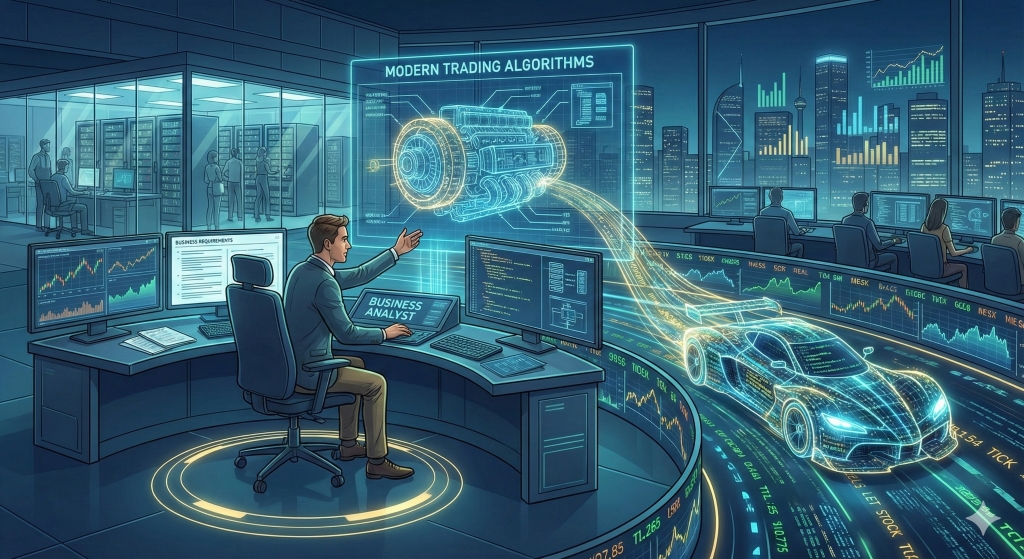
In the architecture of modern finance, the algorithm is the race car, the trader is the driver, and the quant is the engine designer. But the Business Analyst is the Race Engineer. They ensure the car fits the regulations, the engine talks to the wheels, and the driver has the right steering wheel. Without them, the most sophisticated math remains just a theory; with them, it becomes a profit engine.
BA Blocks
Industry Certification Programs:
CFA(Chartered Financial Analyst)
FRM(Financial Risk Manager)
CAIA(Chartered Alternative Investment Analyst)
CMT(Chartered Market Technician)
PRM(Professional Risk Manager)
CQF(Certificate in Quantitative Finance)
Canadian Securities Institute (CSI)
Quant University LLC
· MachineLearning & AI Risk Certificate Program
ProminentIndustry Software Provider Training:
· SimCorp
· Charles River’sEducational Services
Continuing Education Providers:
University of Toronto School of Continuing Studies
TorontoMetropolitan University - The Chang School of Continuing Education
HarvardUniversity Online Courses
Study of Art and its Markets:
Knowledge of Alternative Investment-Art
Disclaimer: This blog is for educational and informational purposes only and should not be construed as financial advice.