

In the financial landscape of 2026, the word of the year isn't "growth" or "inflation"—it’s fragmentation. We live in an era where liquidity, the lifeblood of global markets, is no longer a roaring river but a series of disconnected ponds. While technological advances promised to bring us closer together, a combination of geopolitical shifts, regulatory silos, and the explosion of niche trading venues has done the opposite.
For the average market participant, this isn't just a technical footnote. It is a silent tax. It’s the "leaky bucket" of modern finance where every transaction loses a few drops to the cracks between systems.
To understand the cost, we first have to understand the cause. In 2026, fragmentation is driven by three primary "tectonic shifts":
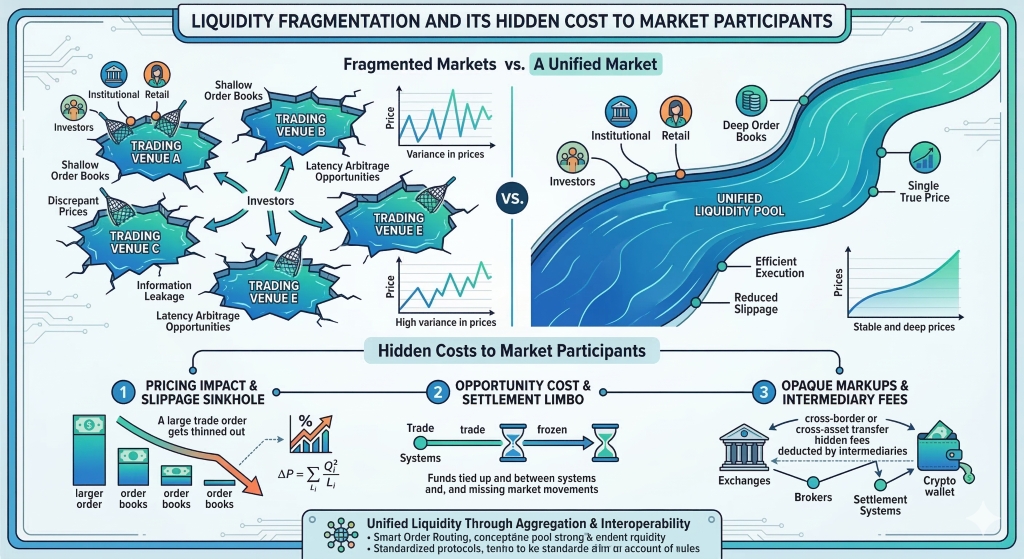
In a perfectly liquid market, you could buy or sell any amount of an asset at the "true" price. In a fragmented market, that price is an illusion. Here is how fragmentation effectively "taxes" your portfolio.
When liquidity is split across ten exchanges instead of one, the "depth" of each individual order book is shallow. If you want to buy 1,000 ETH or a large block of iShares ETFs, no single venue has enough supply.
Fragmentation doesn't just happen in space (where you trade); it happens in time. Despite the "T+0" hype, many cross-border and cross-platform trades still face delays. In 2025/2026, global opportunity costs from settlement delays reached an eye-watering $510 billion.
Example: You sell Amazon stock on a Monday. The cash is "yours," but it sits in a settlement silo for 48 hours. On Tuesday, an AI breakthrough sends NVIDIA up by 8%. Because your funds were in limbo, you missed the move. That 8% is a hidden cost of fragmentation.
Fragmentation breeds intermediaries. Each time you move funds between a crypto wallet, a traditional brokerage, and a foreign currency account, a "middleman" takes a cut.
Recent data shows that while a bank might advertise a "$45 wire fee," the hidden markup on the exchange rate often hovers around 2.5% to 3%. On a $100,000 transfer, that’s $3,000 vanishing into the ether of fragmented systems.
Institutional desks are now forced to run "Smart Order Routers" (SORs) that resemble supercomputers. These algorithms must weigh:
The retail trader often feels the sting through Payment for Order Flow (PFOF). While your "commissions" might be zero, your orders are being routed to wholesalers who profit from the fragmentation. You aren't getting the best price; you're getting the price that was most profitable for the router.
The industry is fighting back. We are seeing a move toward unified liquidity pools.
BA Blocks
Industry Certification Programs:
CFA(Chartered Financial Analyst)
FRM(Financial Risk Manager)
CAIA(Chartered Alternative Investment Analyst)
CMT(Chartered Market Technician)
PRM(Professional Risk Manager)
CQF(Certificate in Quantitative Finance)
Canadian Securities Institute (CSI)
Quant University LLC
· MachineLearning & AI Risk Certificate Program
ProminentIndustry Software Provider Training:
· SimCorp
· Charles River’sEducational Services
Continuing Education Providers:
University of Toronto School of Continuing Studies
TorontoMetropolitan University - The Chang School of Continuing Education
HarvardUniversity Online Courses
Study of Art and its Markets:
Knowledge of Alternative Investment-Art
Disclaimer: This blog is for educational and informational purposes only and should not be construed as financial advice.