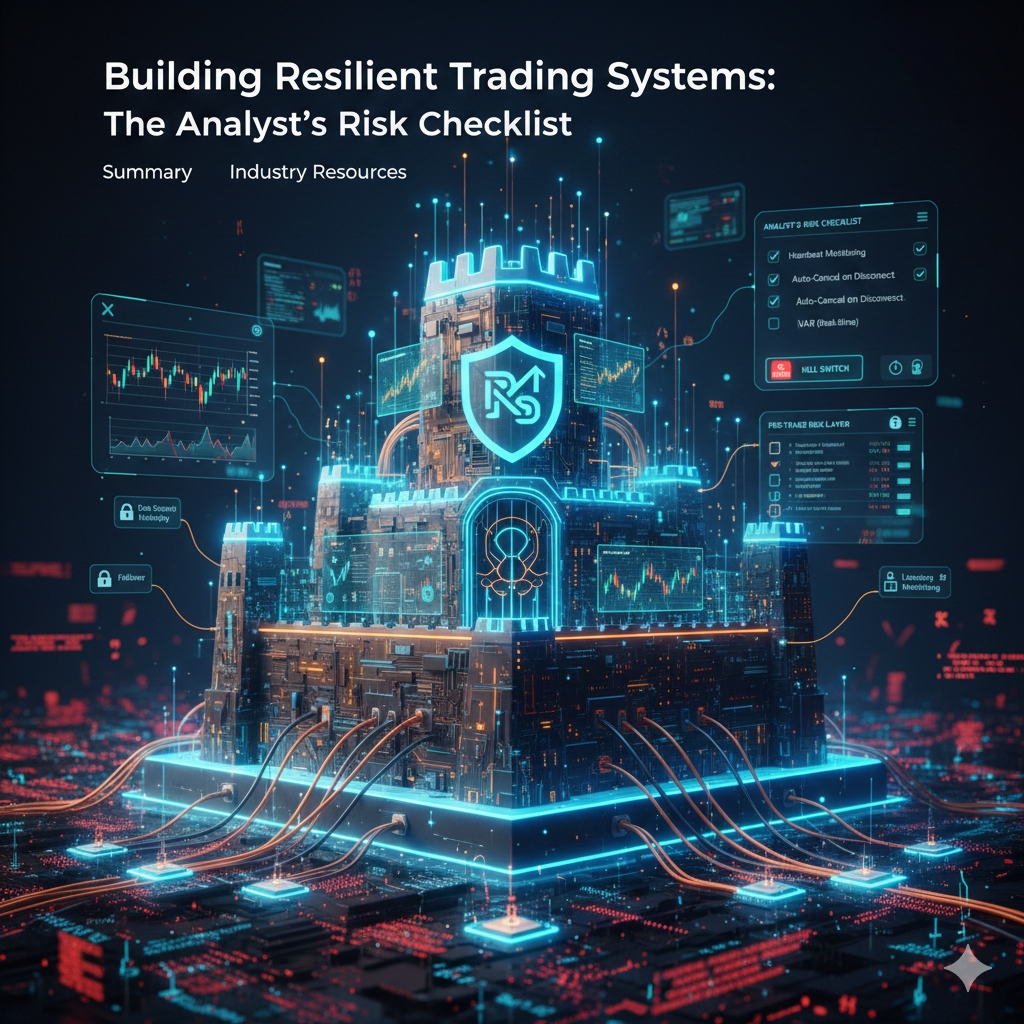
In the high-stakes environment of algorithmic and electronic trading, "resilience" is not a luxury—it is a survival requirement. For a risk analyst, a resilient system isn't just one that makes money; it’s one that survives the "black swans," the "fat fingers," and the API timeouts that inevitably occur.
This guide serves as a comprehensive checklist for building and auditing trading systems that withstand the chaos of the modern market.
1. Structural & Architectural Integrity
Before a single trade is placed, the foundation must be sound. Analysts must scrutinize the "plumbing" of the system.
- Redundancy & Failover: Does the system have a secondary "hot" standby? If your primary server in New Jersey goes down, can your London or Chicago node take over within milliseconds?
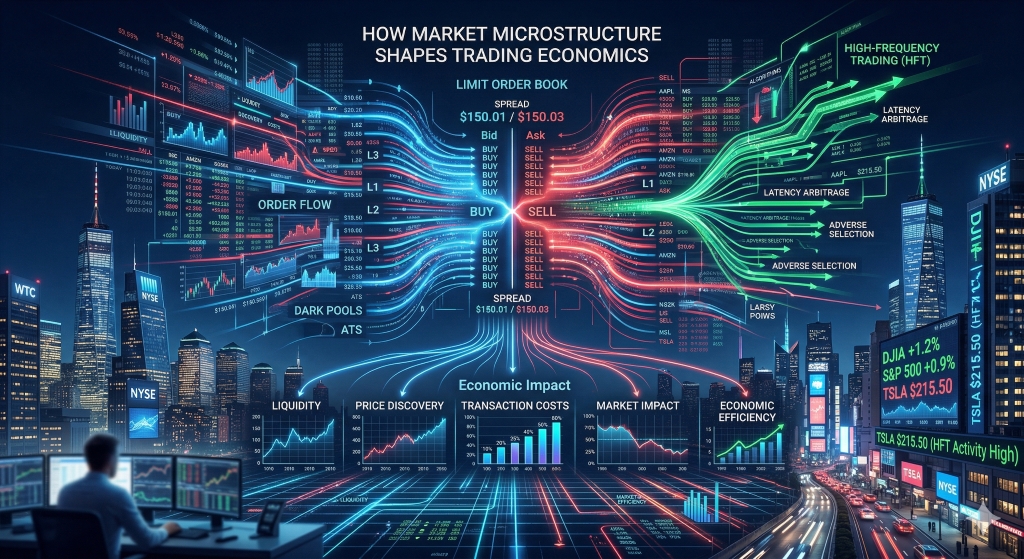
- Latency Monitoring: In a world of HFT (High-Frequency Trading), "jitter" is a risk. You need a checklist item for monitoring the 99th percentile of execution latency.
- Database Integrity: Are your trade logs immutable? A resilient system must ensure that even in a crash, the "State of the World" (current positions and cash) is recoverable.
2. The Pre-Trade Risk Layer
The "Gatekeeper" of your system. This is the code that says "No" when the strategy says "Yes."
- Fat-Finger Limits: Maximum order size and maximum order value per clip.
- Price Collars: Is the order price too far from the current National Best Bid and Offer (NBBO)?
- Frequency Caps: Does the system have a "circuit breaker" for message rates? If a bug causes the system to send 1,000 orders per second, it must self-throttle.
- Restricted List Checks: Automatically blocking symbols that are under regulatory or internal "do not trade" restrictions.
3. Market & Exposure Risks
An analyst must look at the "What if?" scenarios of the portfolio.
- Real-time VaR (Value at Risk): Moving beyond static daily reports to real-time exposure monitoring.
- Correlated Risk: Does the system understand that being long $AAPL$ and long $MSFT$ is often the same risk?
- Liquidity Haircuts: If you hold 20% of the Average Daily Volume (ADV) in a stock, your checklist must account for the "exit cost" during a market rout.
4. The Operational Risk Checklist
Often overlooked, operational resilience is where most systems fail during "boring" times.
Connectivity & API Health
- [ ] Heartbeat Monitoring: Are we receiving a "pulse" from the exchange every $X$ milliseconds?
- [ ] Auto-Cancel on Disconnect: If the connection to the broker drops, does the broker automatically cancel all open resting orders? (Critical for preventing "unattended" fills).
Data Integrity
- [ ] Stale Data Detection: If the price hasn't changed in 60 seconds for a liquid asset, is the feed dead?
- [ ] Outlier Filtering: Do we have logic to ignore "bad prints" or decimal-place errors in the incoming data feed?
5. Post-Trade & Regulatory Resilience
- Reconciliation: An automated "Three-Way Match" between the Strategy’s internal state, the Execution Management System (EMS), and the Broker’s back-office.
- Kill Switch: A manual "Big Red Button" that can be pressed by a human to flatten all positions and disable all algorithms instantly.
Industry Resources for Further Learning
To dive deeper into the technical standards and regulatory requirements, explore these resources:
BA Blocks
· BA Blocks
· BA Block YouTube Channel
Industry Certification Programs:
CFA(Chartered Financial Analyst)
FRM(Financial Risk Manager)
CAIA(Chartered Alternative Investment Analyst)
CMT(Chartered Market Technician)
PRM(Professional Risk Manager)
CQF(Certificate in Quantitative Finance)
Canadian Securities Institute (CSI)
Quant University LLC
· MachineLearning & AI Risk Certificate Program
ProminentIndustry Software Provider Training:
· SimCorp
· Charles River’sEducational Services
Continuing Education Providers:
University of Toronto School of Continuing Studies
TorontoMetropolitan University - The Chang School of Continuing Education
HarvardUniversity Online Courses
Study of Art and its Markets:
Knowledge of Alternative Investment-Art
· Sotheby'sInstitute of Art
Disclaimer: This blog is for educational and informational purposes only and should not be construed as financial advice.