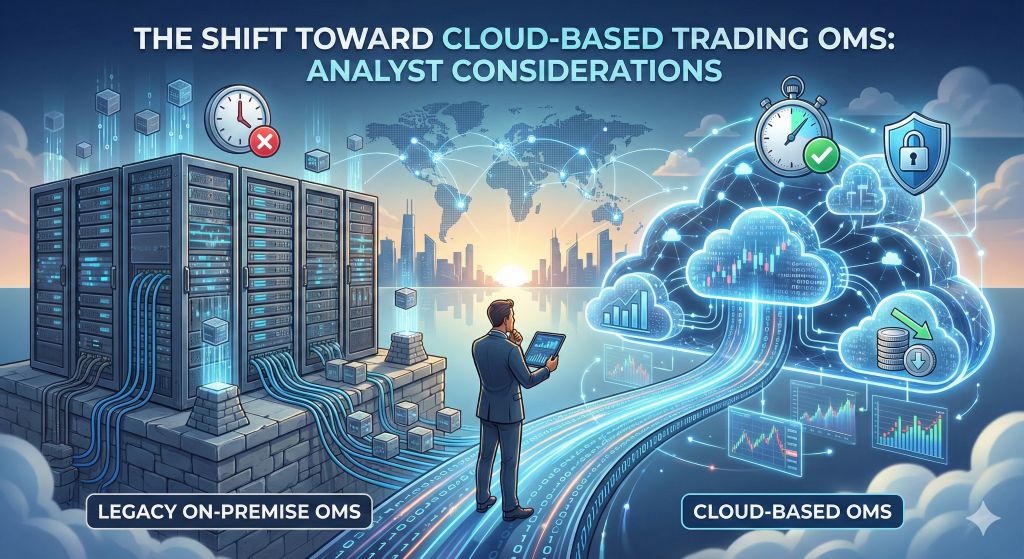


For decades, the Order Management System (OMS) was the fortress of the trading desk—physically installed on local servers, heavily customized, and notoriously difficult to upgrade.
The Legacy Problem:
The Cloud Promise:
SaaS (Software-as-a-Service) OMS platforms flatten these barriers. They offer "continuous delivery" of new features (e.g., new algo wheels, regulatory reporting patches) and elastic scalability.
Analyst Insight: The shift is driven less by cost savings and more by opportunity cost. Firms remaining on-premise are finding they cannot integrate modern AI/ML trade analytics or alternative data feeds fast enough to remain competitive.
The single biggest objection to cloud OMS has always been latency. In High-Frequency Trading (HFT), where nanoseconds count, the speed of light remains a physical constraint.
Recent industry benchmarks suggest that for 90% of buy-side workflows (swing trading, rebalancing, block trading), public cloud latency is negligible. However, for HFT and market-making, the physics of cloud regions (e.g., AWS East vs. NY4 data center) matters.
Key Question for Buyers: Does your alpha come from speed (HFT) or from intelligence (Asset Selection)? If it is the latter, the agility of the cloud outweighs the microsecond penalty.
Ironically, the cloud is now widely considered more secure than most on-premise server rooms. Hyperscalers (AWS, Azure, Google Cloud) spend billions on security—more than any single hedge fund could afford.
However, moving to a SaaS OMS introduces the Shared Responsibility Model:
The Data Sovereignty Trap:
Analysts must verify where the data rests. European firms (under GDPR) and Canadian/APAC firms often have strict residency requirements. A "Global Cloud" OMS must allow you to pin data to specific regions (e.g., "Data never leaves Frankfurt").
The financial argument for Cloud OMS is often misunderstood. It is rarely "cheaper" on a dollar-for-dollar infrastructure basis if you simply "lift and shift" legacy code to the cloud.
The most forward-thinking trend in 2025 is the death of the "All-in-One" monolith. Traders now want a "Best-of-Breed" stack.
Cloud OMS platforms must be API-First. If an OMS cannot easily ingest a JSON stream from a new crypto exchange or output data to Tableau for visualization, it is already obsolete.
The "Desktop Interop" Standard (FDC3): Look for OMS vendors that support FDC3 standards (OpenFin, Glue42). This allows the OMS to "talk" to other apps on the trader's screen locally, bypassing the cloud for UI interactions to save time.
The final consideration is Data Utility.
This enables AI-driven Trading Assistants. Imagine an OMS that alerts a trader: "You usually work this order 15% slower in high-volatility environments; suggesting an aggressive algo." This level of insight is only possible when the OMS is natively connected to cloud-scale data processing.
The shift to Cloud-Based OMS is no longer a "maverick" move; it is the industry standard for firms managing <$100B AUM, and increasingly for the Tier-1 banks as well. The analyst's role is to ensure that the latency profile matches the trading strategy, the security model meets regulatory residency laws, and the cost structure includes FinOps discipline.
BA Blocks
Industry Certification Programs:
CFA(Chartered Financial Analyst)
FRM(Financial Risk Manager)
CAIA(Chartered Alternative Investment Analyst)
CMT(Chartered Market Technician)
PRM(Professional Risk Manager)
CQF(Certificate in Quantitative Finance)
Canadian Securities Institute (CSI)
Quant University LLC
· MachineLearning & AI Risk Certificate Program
ProminentIndustry Software Provider Training:
· SimCorp
· Charles River’sEducational Services
Continuing Education Providers:
University of Toronto School of Continuing Studies
TorontoMetropolitan University - The Chang School of Continuing Education
HarvardUniversity Online Courses
Study of Art and its Markets:
Knowledge of Alternative Investment-Art
Disclaimer: This blog is for educational and informational purposes only and should not be construed as financial advice.