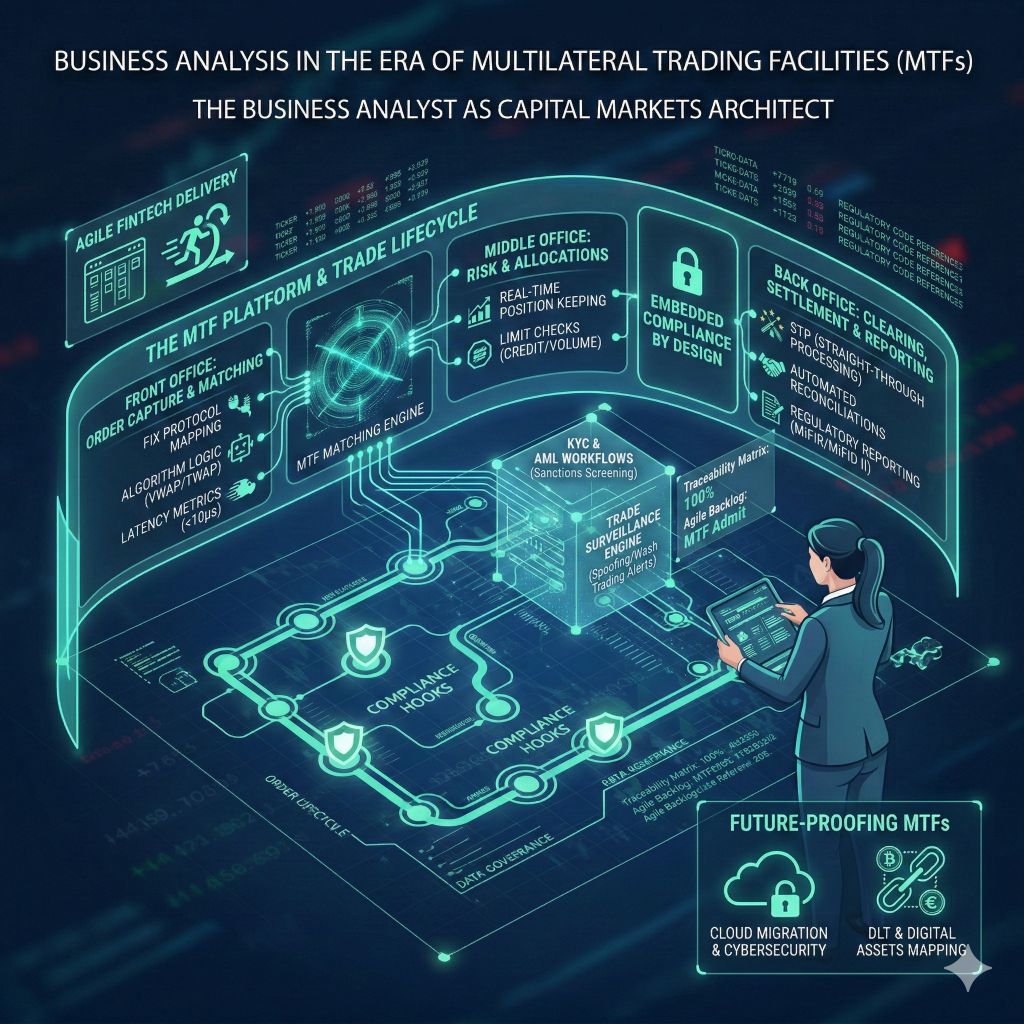


In the high-stakes ecosystem of Capital Markets, the distance between the front office and the technology lab is measured not in meters, but in mindset. On one side, you have Traders: driven by adrenaline, market volatility, and the ruthless pursuit of Alpha. They think in milliseconds, PnL (Profit and Loss), and execution speed. On the other side, you have OMS Developers: architects of stability, obsessed with code quality, scalability, and system resilience. They think in sprints, technical debt, and edge cases.
When these two worlds collide without a buffer, the result is often "requirements friction"—a costly phenomenon where features are built but never used, or critical market nuances are lost in translation, leading to trade breaks or regulatory fines.
Enter the Capital Markets Business Analyst (BA). Far from just a scribe for meeting minutes, the modern BA is the diplomatic envoy, the technical translator, and the strategic bridge that ensures the Order Management System (OMS) isn't just a piece of software, but a competitive weapon.
To understand the bridge, we must first understand the chasm.
The Trader’s Reality:A trader’s workflow is non-linear and reactive. If the market moves 50 basis points on a central bank announcement, they need a "Cancel/Replace" button now. They don't care about the backend database schema or the API gateway's rate limits. To them, technology is a utility—like electricity. It just needs to work, instantly.
The Developer’s Reality:Developers are tasked with building systems that process billions of dollars in volume without failing. When a trader asks for a "simple button," the developer sees a complex chain of events: How does this impact the FIX engine? Does this break the pre-trade risk check? Will this introduce latency?
The Conflict:
The most successful Business Analysts in Capital Markets are "bilingual." They speak the language of Finance (Liquidity, Spread, Fill Rate, Greeks) and the language of Technology (API, JSON, Latency, Throughput).
Traders rarely state requirements; they state problems.
The BA takes the emotional frustration of the front office and converts it into a ticket that a developer can actually code against.
A major value add of the BA is "scope shielding." Traders have infinite ideas but finite patience. If developers were exposed to every raw request from the desk, they would never finish a sprint. The BA acts as a filter, validating which requests are true business necessities versus "nice-to-haves," and helping prioritize them based on ROI.
The days of BAs relying solely on Excel and Visio are over. To effectively bridge the gap in modern OMS development, BAs are increasingly technical.
The Request: A Head of Equities wants a "one-click" workflow to dump residual positions at the market close (MOC).
The BA's Journey:
As Artificial Intelligence enters the OMS landscape, the BA's role is shifting again. We are moving from Deterministic Logic (If X, then Y) to Probabilistic Logic (AI predicts Y).
BAs will soon be defining "Guardrails" for AI rather than strict requirements for software. They will need to answer questions like: If our Smart Order Router (SOR) uses AI to route orders, how do we explain the decision to the regulator? The BA becomes the ethical and functional guardian of the trading algorithms.
In the ecosystem of Capital Markets, the code is the engine, and the capital is the fuel. But the Business Analyst is the transmission. Without them, the engine revs high, the fuel burns fast, but the vehicle doesn't move forward. By bridging the cultural and technical divide between the risk-takers and the system-builders, BAs ensure that technology investments translate directly into trading performance.
To learn more about the standards and organizations mentioned in this post, visit:
BA Blocks
Industry Certification Programs:
CFA(Chartered Financial Analyst)
FRM(Financial Risk Manager)
CAIA(Chartered Alternative Investment Analyst)
CMT(Chartered Market Technician)
PRM(Professional Risk Manager)
CQF(Certificate in Quantitative Finance)
Canadian Securities Institute (CSI)
Quant University LLC
· MachineLearning & AI Risk Certificate Program
ProminentIndustry Software Provider Training:
· SimCorp
· Charles River’sEducational Services
Continuing Education Providers:
University of Toronto School of Continuing Studies
TorontoMetropolitan University - The Chang School of Continuing Education
HarvardUniversity Online Courses
Study of Art and its Markets:
Knowledge of Alternative Investment-Art
Disclaimer: This blog is for educational and informational purposes only and should not be construed as financial advice.